Why Your BJJ Grip Gives Out Before Your Cardio Does
Quick Answer: Forearm and grip endurance is a separate energy system from cardiovascular conditioning, and most BJJ training doesn’t isolate it directly — dedicated grip-specific work, not more rolling rounds, is what actually closes the gap.
It feels like a cardio problem because you’re breathing hard when your grip finally gives out, but the actual limiting factor is often local muscular endurance in your forearms failing well before your cardiovascular system does.
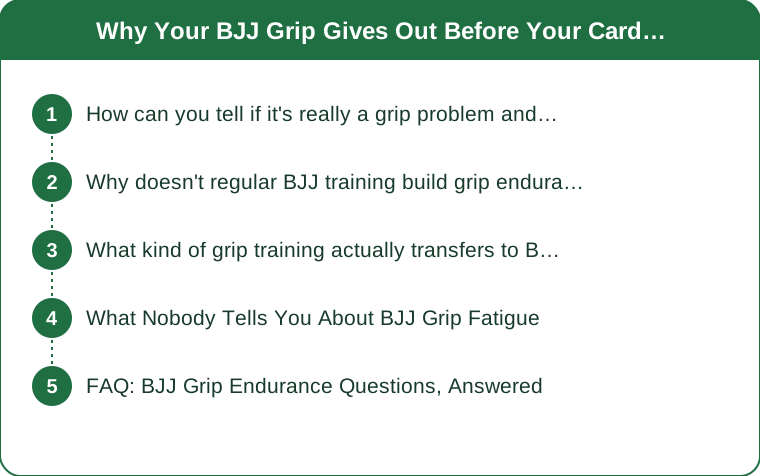
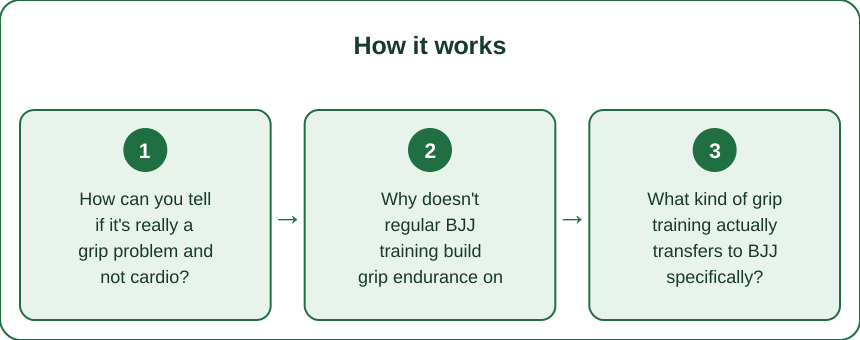
How can you tell if it’s really a grip problem and not cardio?
If your breathing still feels manageable but your hands physically can’t maintain a grip, that’s a strong sign the limiter is local forearm endurance, not cardiovascular capacity. Grip failure that happens at a consistent point in every round, regardless of how hard you’re breathing, points to the same conclusion.
Why doesn’t regular BJJ training build grip endurance on its own?
Grip demand during rolling is inconsistent — some exchanges are grip-heavy, others aren’t — so your forearms get intermittent rather than progressive overload. Dedicated grip work applies consistent, progressive load, which is what actually builds the specific endurance rolling alone doesn’t reliably provide.

What kind of grip training actually transfers to BJJ specifically?
Gi-specific grip work (dead hangs from a folded gi lapel, or towel-based hangs) transfers more directly than generic gripper tools, since the grip pattern more closely matches what you use on the mat. Static holds (30-60 second dead hangs) tend to build the sustained-grip endurance BJJ actually demands, more than explosive grip work does.
What Nobody Tells You About BJJ Grip Fatigue
Grip fatigue is often technique-masked, not just strength-limited. A significant amount of unnecessary grip fatigue comes from gripping tighter than the position actually requires — many practitioners maintain a maximal grip through positions where a lighter, more efficient grip would hold just as well and preserve forearm endurance for later in the round.
FAQ: BJJ Grip Endurance Questions, Answered
How often should dedicated grip training be added to a BJJ schedule?
2-3 short sessions per week (10-15 minutes) is typically enough to see meaningful improvement without interfering with mat training recovery.
Does grip strength training risk overtraining hands and forearms if I’m already training BJJ frequently?
It can, if volume isn’t managed — starting with shorter, less frequent sessions and monitoring forearm soreness is the safer approach.
Is grip endurance more important than raw grip strength for BJJ?
For most positions, yes — the ability to sustain a moderate grip over a long roll matters more than a single maximal-strength grip.
TL;DR:
- Grip failure at a consistent point, despite manageable breathing, signals a local endurance limit
- Rolling alone doesn’t provide consistent progressive grip overload
- Gi-specific static holds transfer more directly than generic grip tools
- Gripping tighter than a position requires wastes forearm endurance you’ll need later
Keep Reading
This article is for general informational and styling purposes only. Fit, sizing, and product availability may vary.