How to Come Back to BJJ After a Summer Off Without Getting Hurt in Week One
Quick Answer: After six to twelve weeks off, your technique is largely intact, your conditioning is down substantially, and your connective tissue - fingers, neck, knees, shoulders - has lost its specific tolerance for grappling loads. Injuries in week one come from the third category, not the first two. Come back with three rounds instead of six, tap early and often, avoid competitive rolls with anyone you have something to prove to for two weeks, and expect grip and neck to be the limiting tissues.
You will feel fine in the first round and be a liability by the fourth. That is not a fitness problem, and pushing through it is how comebacks turn into six more weeks off.

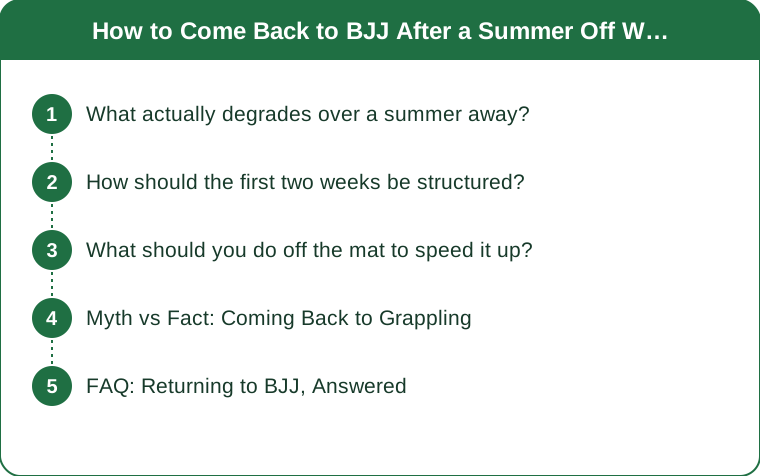
What actually degrades over a summer away?
Cardio drops the most and returns the fastest. Grappling-specific conditioning is a strange blend of aerobic capacity, anaerobic tolerance, and isometric endurance, and it falls noticeably after a month off. It also rebuilds within about three to four weeks of consistent training, which makes it the least worrying item on the list.
Technique degrades far less than people fear. Motor patterns built over hundreds of hours persist. What actually declines is timing and the speed of recognition - you still know the escape, you just see the opportunity a beat later, which in a live roll is the difference between escaping and not.
Grip endurance falls off a cliff and is the most common week-one complaint. Gripping a gi is a very specific isometric demand that essentially nothing else replicates, and forearm endurance drops sharply after several weeks. This drives the flat, useless feeling in round three.
The neck loses conditioning quietly and this is the one to respect. Cervical musculature adapts to the loads of grappling, and that adaptation fades. Neck strains in the first week back are extremely common and disproportionately annoying, because they interfere with everything including sleep and driving.
And joint tolerance is separate from strength. Fingers, knees, and shoulders develop a tolerance for grappling-specific loading that is distinct from how strong you are. This is why someone who lifted weights all summer can still tweak a finger in their first session back - the strength was maintained and the tolerance was not.
How should the first two weeks be structured?
Session one: drill only, or drill plus one very light flow roll. No competitive rounds. This feels excessive and it is the single most effective injury prevention measure available, because week-one injuries cluster overwhelmingly in hard rolls.
Weeks one and two: cap rolling at three rounds even if you feel fine. You will feel fine after two. The fatigue that causes injury is not the fatigue you notice at the time - it is the reduced ability to recognise a bad position early, and that degrades before you feel tired.
Pick your partners deliberately for the first fortnight. Higher belts who can control the pace, or training partners you trust. The dangerous roll is with a newer, stronger, enthusiastic person who does not know how to modulate, and with anyone you feel competitive with.
Tap absurdly early on anything involving fingers, neck, or knees. These are the tissues with reduced tolerance and the ones with the longest recovery times. There is no information gained from finding out where your knee’s limit is in your first week back.
Two to three sessions a week rather than four or five. Recovery capacity for grappling-specific soreness is also detrained, and the delayed onset soreness after a first session back is substantially worse than usual. Give it 48 hours.

What should you do off the mat to speed it up?
Grip work, two or three times a week, is the highest-value addition. Dead hangs from a bar, gi towel hangs if you can rig one, and farmer’s carries. Two to three sets of 20 to 40 seconds is enough, and it rebuilds forearm endurance considerably faster than rolling alone does.
Neck work should be gentle and isometric to start. Light resisted holds in four directions with your own hand, ten seconds each, building over weeks. Avoid aggressive neck bridging in the first fortnight - it is a common route to exactly the strain you are trying to prevent.
Basic posterior chain strength transfers well: rows, hip hinges, and single-leg work. These support the positions grappling demands and can be maintained through any layoff, which is why people who lifted through the summer still come back with better positional strength even if their cardio is gone.
Aerobic base work makes the third round survivable. Twenty to thirty minutes of easy cycling, rowing, or brisk walking three times a week rebuilds the aerobic component faster than rolling does and without the injury exposure.
And mobility work for hips and shoulders, specifically. Not stretching for its own sake - the specific ranges grappling demands, which for most people means hip internal and external rotation and shoulder external rotation. Ten minutes twice a week is enough to keep the guard positions comfortable.
Myth vs Fact: Coming Back to Grappling
Myth: you lose your technique after a few months off. Fact: technique is remarkably durable. What degrades is timing, recognition speed, and the physical capacity to execute under fatigue. The knowledge is there - the ability to apply it at speed takes a few weeks.
Myth: you should train through the first two weeks to get fit faster. Fact: injury risk is highest exactly when conditioning is lowest and enthusiasm is highest. Two conservative weeks costs you almost nothing in fitness and prevents the setback that actually costs months.
Myth: getting submitted a lot means you have lost it. Fact: it means your timing is a beat slow and your gas tank is small, both of which resolve on a predictable schedule. The people who quit during a comeback almost always quit during the two weeks where this is at its worst.
Myth: if you stayed fit over the summer you can pick up where you left off. Fact: general fitness does not transfer to grip endurance, neck conditioning, or joint tolerance for grappling loads. Runners and lifters are frequently the most surprised by how limited they feel in round two.
Myth: soreness after the first session means you did it right. Fact, and this one matters: severe soreness after a first session back is a sign the session was too hard, not that it was productive. Grappling-specific soreness is unusually deep and long-lasting, and a session that leaves you unable to train for four days has cost you more than it delivered.
FAQ: Returning to BJJ, Answered
How long does it take to get back in shape for BJJ?
Grappling-specific conditioning typically returns within three to four weeks of consistent training after a summer off. Grip endurance takes a similar period, and timing usually feels normal again by around the third or fourth week. Technique itself is largely intact from session one.
Should I roll hard on my first day back?
No. Drill only, or drill plus one light flow roll. Week-one injuries cluster overwhelmingly in competitive rounds, and there is nothing to be gained from testing yourself against a body that has lost its joint and neck conditioning even if its strength is intact.
Why do my forearms give out so fast after time off?
Gripping a gi is a specific isometric demand that almost no other activity replicates, so forearm endurance drops quickly and is not maintained by general fitness. Dead hangs and farmer’s carries two or three times a week rebuild it considerably faster than rolling alone.
How do I avoid injury coming back to jiu jitsu?
Cap rolls at three rounds for two weeks, choose partners who control pace, tap early on anything involving fingers, neck, or knees, and train two to three times a week rather than five. Add grip and gentle isometric neck work off the mat. Any pain that persists beyond a couple of days deserves a professional assessment rather than another round - this is general information, not medical advice.
TL;DR:
- Technique survives a layoff; conditioning, grip endurance, neck conditioning, and joint tolerance do not.
- Week-one injuries come from the tissue category, not the fitness one, and cluster in hard competitive rolls.
- Session one is drilling only; cap rolling at three rounds for two weeks even when you feel fine after two.
- Choose partners who control pace, and tap absurdly early on fingers, neck, and knees.
- Off the mat: dead hangs and carries for grip, gentle isometric neck holds, rows and hinges, and easy aerobic work three times a week.
- Expect timing to be a beat slow and submissions to be frequent for about three weeks - that is the schedule, not a verdict.
Two conservative weeks cost you nothing. One bad first session costs six.
Keep Reading
This article is for general informational and styling purposes only. Fit, sizing, and product availability may vary.