5 Mat Etiquette Mistakes Every BJJ White Belt Makes (and How to Fix Them Fast)
Quick Answer: The most common white belt etiquette mistakes are rolling too hard with beginners, skipping hygiene basics (nails, gi cleanliness), not tapping early enough, showing up late without acknowledging the instructor, and giving unsolicited technique advice to other white belts. None of these are malicious — they’re just unwritten rules nobody explained.
BJJ gyms run on a dense set of unwritten social rules that took the people currently enforcing them years to absorb. Most white belt etiquette mistakes aren’t about disrespect — they’re just genuinely not obvious until someone tells you.

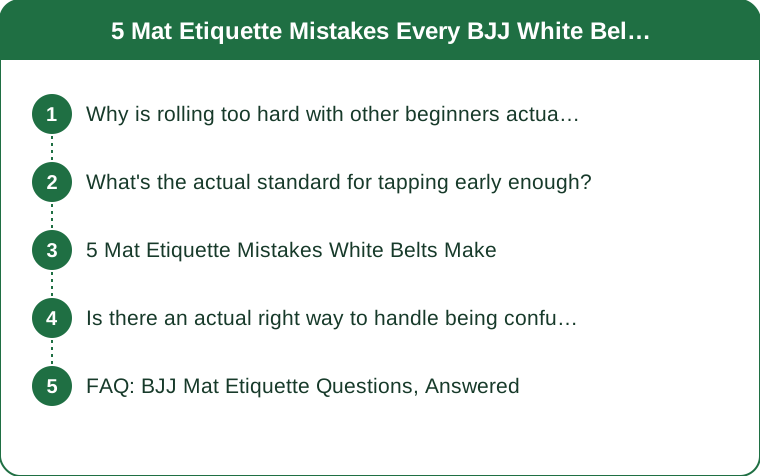
Why is rolling too hard with other beginners actually a real problem?
Because BJJ’s entire long-term training model depends on partners being safe enough to train with regularly — a white belt going full intensity against another white belt, especially with strength instead of technique, creates injury risk disproportionate to the skill level involved. Injuries early in someone’s BJJ journey are one of the most common reasons people quit entirely.
Matching intensity to your partner’s experience and control level, not to your own competitiveness, is one of the fastest ways to earn trust on the mat as a new student.
What’s the actual standard for tapping early enough?
Tap the moment a submission is secure and you feel real pressure building, not when it’s already painful. New students often wait too long, either out of pride or because they’re still learning to recognize a fully locked submission versus one still being adjusted. Tapping early costs you nothing in a training roll — there’s no reward for absorbing unnecessary pain or risking injury to avoid tapping a second earlier.
Experienced training partners specifically watch for this in new students and adjust their own pressure accordingly, but tapping promptly is still your responsibility, not just theirs.

5 Mat Etiquette Mistakes White Belts Make
1. Rolling at full intensity with other beginners, escalating a training roll into unnecessary risk.
2. Skipping basic hygiene — untrimmed nails, an unwashed gi, or training while visibly sick all directly affect training partners.
3. Tapping too late, out of pride rather than safety awareness.
4. Showing up late and stepping onto the mat without bowing or acknowledging the instructor, which reads as disrespectful even when unintentional.
5. Coaching other white belts unsolicited during class — technique correction is the instructor’s role; a fellow beginner giving advice is often working from incomplete understanding themselves.
Is there an actual right way to handle being confused about mat etiquette instead of guessing?
Just ask a higher belt or the instructor directly — this is genuinely the norm, not an imposition. Every experienced practitioner was a confused white belt once, and most gyms have a culture of higher belts mentoring newer ones specifically because the unwritten rules aren’t written anywhere obvious.
Asking ‘is there a specific etiquette for X’ after class is one of the fastest ways to close the gap, faster than guessing and accidentally causing friction.
FAQ: BJJ Mat Etiquette Questions, Answered
Is it okay to ask a higher belt for etiquette advice directly?
Yes, this is completely normal and welcomed at most gyms — asking directly is far better received than guessing and getting it wrong.
How do I know if I’m rolling too hard with a beginner partner?
If your partner seems tense, is getting injured-adjacent (joint strain, being overpowered rather than out-technique’d), or visibly hesitant to roll with you again, that’s a signal to dial back intensity.
What should I do if I show up late to class?
Quietly bow onto the mat, acknowledge the instructor with eye contact or a nod when there’s a natural pause, and join in without disrupting the current drill.
TL;DR:
- Match rolling intensity to your partner’s level, not your own competitiveness
- Tap the moment pressure builds, not when it’s already painful
- Basic hygiene directly affects everyone you train with
- When unsure about etiquette, just ask — every higher belt was a confused white belt once
None of these mistakes are about being a bad training partner — they’re just rules nobody wrote down. Ask, and the gap closes fast.
Keep Reading
This article is for general informational and styling purposes only. Fit, sizing, and product availability may vary.