Your BJJ Progress Is Stalling on Rest Days, Not Mat Days
Quick Answer: BJJ is unusually taxing because every roll is a maximal-effort, unpredictable, full-body eccentric event with grip work layered on top - and it’s done at a volume no strength coach would prescribe. If you’re training four-plus times a week and going backwards, the fix is almost always sleep, protein, and one genuine rest day, not more drilling. Grip strength failing before your cardio is the earliest reliable warning sign.
The standard response to a plateau is to train more. In BJJ specifically, that’s often what caused it.

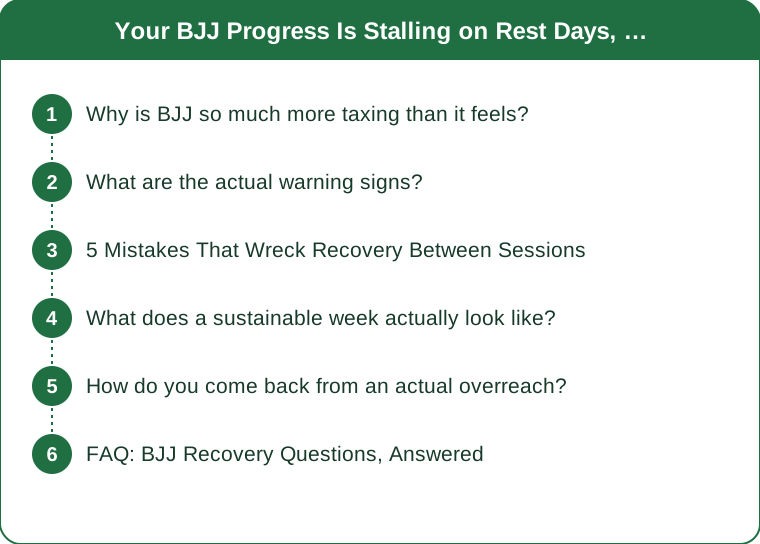
Why is BJJ so much more taxing than it feels?
Because the effort is invisible and unmeasured, which makes the load easy to underestimate.
A six-minute roll is a maximal effort with no pacing. You don’t choose the intensity - your partner does. Unlike a run or a lifting session where you control the output, a roll against a fresh higher belt is a near-maximal effort you cannot moderate.
It’s almost entirely eccentric and isometric. Holding a grip, resisting a pass, defending a position - these are muscles producing force while being lengthened or held under tension. That’s the loading pattern most associated with muscle damage and delayed soreness, and BJJ is full of it.
The forearms take a specific beating. Gripping a gi is a sustained isometric contraction at high intensity, repeated for the entire session. Forearm and hand tissues recover slowly, and grip is often the first system to show cumulative fatigue.
And the volume is extreme by any other standard. A five-round open mat is five maximal-effort intervals with short rest, after an hour of drilling. Prescribe that four times a week to a strength athlete and every coach in the building would object. In BJJ it’s considered normal and people add a fifth session.
None of this means train less as a rule. It means the recovery side has to be proportionate to a load most people never actually account for.
What are the actual warning signs?
In rough order of how early they appear.
1. Grip failing before your cardio. The earliest and most reliable signal. If your hands open on a lapel while your breathing is still fine, your forearms haven’t recovered from the last session. This one precedes everything else by weeks.
2. Waking up unrefreshed after adequate hours. Eight hours in bed and still tired is a systemic fatigue signal, not a sleep-hygiene problem.
3. Resting heart rate creeping up. A morning resting heart rate 5-10 beats above your normal, sustained across several days, is a well-established marker of incomplete recovery and any wearable will show it.
4. Losing to people you normally handle. Not occasionally - consistently, across a couple of weeks. Technical skill doesn’t disappear; the ability to express it under fatigue does.
5. Irritability and dreading class. Motivation collapse is a genuine physiological signal, not a character flaw. When the thing you love feels like an obligation for two weeks straight, that’s data.
6. Nagging injuries that don’t resolve. Fingers, elbows, and necks that stay sore for weeks rather than days. Connective tissue recovers more slowly than muscle, and it’s usually the first thing to accumulate damage.
Two or more of these together, sustained for more than a week, is a recovery problem - and adding a session will make every one of them worse.
5 Mistakes That Wreck Recovery Between Sessions
Mistake 1: Treating an easy roll as rest. A ‘light’ open mat is still hours of grip work and eccentric loading. Active recovery in BJJ means walking, mobility, or swimming - not going to the gym and rolling gently. There is no light version of grip fatigue.
Mistake 2: Undereating protein. BJJ produces substantial muscle damage, and repair requires substrate. Commonly cited targets sit around 1.6-2.2g of protein per kg of bodyweight per day for people training hard - and most recreational grapplers are well under that without realising.
Mistake 3: Training late and sleeping badly. Evening classes finish with elevated heart rate, body temperature, and adrenaline, and then people scroll for an hour. Sleep is where the adaptation actually happens, and a 9pm class that pushes bedtime to 1am is quietly cancelling the session’s benefit.
Mistake 4: Adding strength training without removing anything. Lifting three times a week on top of four BJJ sessions isn’t a complementary programme; it’s seven hard days. Strength work is valuable and it has to displace something.
Mistake 5: Never taking a full week off. A planned deload week every 8-12 weeks is standard practice in every other sport and near-heretical in BJJ. People who take one almost universally report coming back better - which tells you what the accumulated fatigue was costing.

What does a sustainable week actually look like?
Three templates by training age. All assume a full-time job and normal life.
Beginner - 2-3 sessions a week. Two technique classes and one open mat. Resist the urge to go to five. The first year is a motor learning problem, and motor learning is consolidated in sleep, not accumulated in extra mat time. Beginners who go five times a week have a well-documented tendency to be injured or gone within six months.
Intermediate - 3-4 sessions. Three classes plus one open mat, with at least two complete rest days, ideally not consecutive. One optional strength session, kept short and heavy rather than long and fatiguing. This is the sweet spot for most people with jobs.
Advanced or competing - 4-5 sessions, periodised. Hard days genuinely hard, easy days genuinely easy, and a deload week every 8-12 weeks. The distinguishing feature of people who train this much sustainably isn’t toughness - it’s that their easy days are actually easy.
Non-negotiables across all three:
- 7-9 hours of sleep. The most effective recovery intervention available and the one most often traded away.
- Protein at every meal, hitting the daily target rather than backloading it all at dinner.
- One full rest day minimum, with no gym of any kind.
- Grip-specific rest. If your forearms are cooked, that’s the system to protect - drill no-gi or positional work rather than gripping for another two hours.
How do you come back from an actual overreach?
Faster than people fear, if you address it early.
Step 1 - Take five to seven days completely off the mat. Not reduced. Off. This feels excessive and it’s the intervention that works. Walk, sleep, eat properly. Most people report feeling notably better by day four, which is itself diagnostic.
Step 2 - Return at half your previous volume for two weeks. If you were doing four sessions, do two. Technique classes, positional drilling, minimal hard rolling. Rebuild the base before adding intensity back.
Step 3 - Add back one session at a time, holding for two weeks each. This is slower than anyone wants and it’s how you find your actual sustainable ceiling rather than rediscovering the ceiling by hitting it again.
Step 4 - Fix the input that caused it. Almost always sleep, food, or life stress rather than the training itself. A stressful period at work reduces your recovery capacity even if your training didn’t change - which is why plateaus so often coincide with things that have nothing to do with jiu-jitsu.
When it’s more than overreaching: persistent joint pain, numbness or tingling in the hands, unexplained weight loss, or fatigue that doesn’t improve with a week off are worth an actual medical opinion. Grapplers are unusually good at normalising symptoms that would send anyone else to a doctor. This is general information, not medical advice.
And the reframe that helps most: your skill doesn’t decay in a week off - your fatigue does. People come back from a rest week sharper, and it’s not a coincidence.
FAQ: BJJ Recovery Questions, Answered
How many times a week should I train?
Most people with jobs sustain 3-4 sessions well. Beginners should sit at 2-3 for the first six months regardless of enthusiasm, because injury risk is highest and skill retention is sleep-limited.
Is soreness a sign of a good session?
Not reliably. Soreness tracks novelty and eccentric load more than it tracks quality of training, and chronic soreness across weeks is a recovery signal rather than a badge.
Can I lift and train BJJ in the same week?
Yes - keep lifting short, heavy, and low-volume, and make sure it displaces a mat session rather than being added on top. Two lifting sessions with three BJJ sessions works for most people.
How long should a deload week be?
A full week, every 8-12 weeks. Either complete rest or drilling-only at low intensity. The people who report the biggest benefit are the ones who resisted it longest.
TL;DR:
- Every roll is a maximal, unpaced, eccentric-heavy effort with sustained grip work on top
- Grip failing before your cardio is the earliest reliable overreaching signal
- A ‘light roll’ is not a rest day - grip fatigue has no light version
- 3-4 sessions with two genuine rest days sustains most people with jobs
- Take five to seven days fully off; skill doesn’t decay in a week, fatigue does
The plateau isn’t asking for another session. It’s asking for a night’s sleep and a Tuesday off.
Keep Reading
This article is for general informational and styling purposes only. Fit, sizing, and product availability may vary.