Coming Back to BJJ After a Summer Off Without Getting Hurt in Week One
Quick Answer: Your technique comes back much faster than your conditioning, your grip strength, and your neck — which is exactly the combination that produces injuries. Plan for two weeks of deliberately reduced intensity: drill more than you roll, roll with people you trust, tap early and often, and accept that your cardio will be embarrassing before your technique is. Grip and neck are the two things to rebuild before you need them.
Every September the mats fill up with people coming back after a summer of travel, heat, and skipped sessions.
A meaningful number of them are injured within two weeks. Almost none of it is bad luck.

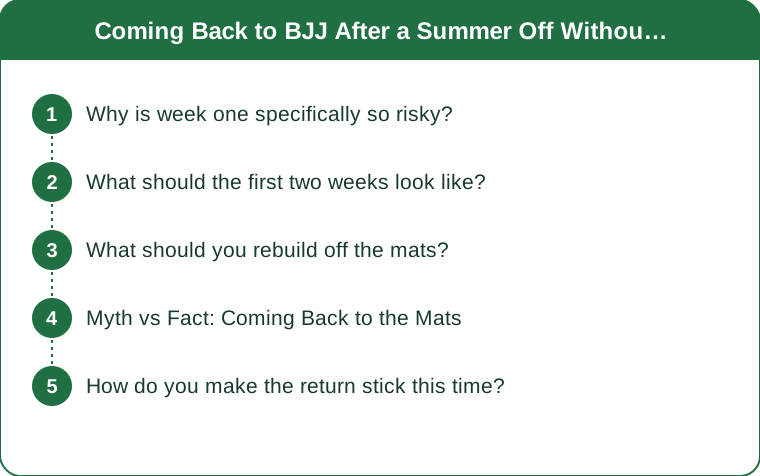
Why is week one specifically so risky?
Because of a mismatch between what came back quickly and what didn’t.
Technique and reflexes return fast. Motor patterns are durable — you’ll remember your guard passes and your escapes within a session or two. This is genuinely great and it’s also the trap, because it makes you feel ready.
Conditioning does not return fast. Aerobic capacity declines measurably within two to four weeks of stopping and keeps declining. After a summer off you might be down substantially. Fatigue is where technique degrades and where you start using strength instead of position.
Grip strength is the specific weak point. Gripping a gi is a very particular endurance demand that nothing else replicates. Your forearms will fail long before your legs, and failing grips means you get pulled into positions you’d normally prevent.
Connective tissue lags behind muscle. Tendons and ligaments adapt more slowly than muscle does, both in building up and in retaining. So even where you feel strong, the structures around the joints are less prepared than they were in June.
Your neck and your fingers, specifically. These two take the most direct load in BJJ and they detrain quickly. Neck stiffness after the first session back is nearly universal.
Put it together: you feel technically capable, you gas quickly, you grip poorly, and your joints are underprepared. That’s the recipe.
What should the first two weeks look like?
A concrete plan rather than an intention to take it easy, because nobody takes it easy in a roll without a rule they set beforehand.
Week 1 — two sessions, drilling-heavy.
- Attend class, do the full warm-up and technique portion.
- Roll no more than two rounds, and only with training partners you know and trust. Not the new white belt with something to prove, and not the person who was competing all summer.
- Tell your partners you’re coming back. Anyone worth training with will adjust.
- Expect to be exhausted after two rounds. That’s the accurate signal.
Week 2 — two or three sessions, add rounds slowly.
- Three to four rounds, still with chosen partners.
- Start including a harder round at the end when you’re already tired, deliberately, so you practice good decisions while fatigued.
Week 3 onward — normal, roughly.
- Full rounds, wider range of partners.
- Conditioning will still be behind. That’s fine and it resolves over another few weeks.
Throughout, the rule that matters most: tap early. Your flexibility and your joint tolerance are both below where they were, which means submissions arrive faster and with less warning. A tap costs nothing. Coming back after a summer off and immediately taking three months off with an injured elbow costs everything.

What should you rebuild off the mats?
Three things, and grip is first.
Grip endurance. The single highest-return off-mat work for BJJ. Dead hangs from a bar — 3 to 5 sets of maximum hold, twice a week — plus towel hangs or gi-grip hangs if you can rig them. It’s boring and it directly prevents the fatigue that causes bad positions.
Neck. Underrated and important. Gentle isometric neck work — pressing your head into your hand in four directions, 10 seconds each, 2 to 3 rounds, daily — builds tolerance for the loading BJJ puts through the cervical spine. Start light. Never force range.
Aerobic base. Not sprints. Two to three easy sessions a week — a 30 to 40 minute run, bike, or brisk walk at a conversational pace. Aerobic capacity is what determines your recovery between rounds, and it rebuilds fastest with easy volume rather than hard intervals.
Plus one more: hip and shoulder mobility, ten minutes most days. A summer of sitting has almost certainly reduced your hip internal rotation and your shoulder range, and both of those show up immediately in guard retention and in escapes.
A realistic weekly shape for the first month: two mat sessions, two easy aerobic sessions, two grip sessions, daily neck and mobility. That’s more off-mat work than most people do, and it’s the difference between a clean return and a stop-start one.
Myth vs Fact: Coming Back to the Mats
Myth: You’ll have lost all your technique. Fact: You’ll have lost far less than you fear. Motor patterns are durable and most people are surprised how quickly it returns. What you’ve lost is conditioning, grip, and timing — and timing comes back within a few sessions.
Myth: The best way back is to just train through it hard. Fact: This is how the injuries happen. There’s no fitness benefit available in week one that’s worth a six-week layoff.
Myth: Rolling is the best conditioning for rolling. Fact: Partly true and incomplete. Rolling builds specific conditioning brilliantly, but it does so at high injury risk when your base is low. Building an aerobic base off the mats first means you can roll more, sooner, and safer.
Myth: Soreness in your neck after the first session means something is wrong. Fact: Generalized neck stiffness after a first session back is extremely common and usually resolves in a couple of days. Sharp pain, pain radiating into an arm, numbness, or tingling is a different matter and warrants a doctor, not a rest day.
Myth: You should go straight back to the same training frequency. Fact: The third point is the one that catches experienced grapplers hardest — they know rolling gets them fit, so they roll hard immediately, and their aerobic base isn’t there to support it. Build to your old frequency over a month.
This is general information, not medical advice — if you’re returning from an actual injury rather than just time off, that’s a conversation with a professional.
How do you make the return stick this time?
The return that fails usually fails in week four or five, not week one — after the initial enthusiasm and before it’s a habit again.
Fix the schedule, not the frequency. Two specific classes on specific days beats a plan to go three or four times. A fixed slot survives a bad week.
Pick the sessions that fit your actual autumn, not your summer. If your evenings are now claimed, find a morning or a lunchtime class. Trying to reinstate a schedule that no longer fits your life is the most common failure.
Have a training partner expecting you. The single strongest predictor of attendance.
Set a goal that isn’t fitness. A specific technique to develop, a competition in the spring, a stripe. Vague intentions to get back in shape don’t survive November.
Plan for the December dip in advance. Decide now that you’ll drop to one session a week for a few weeks over the holidays rather than stopping. A planned reduction is a pause; an unplanned one is how a year off starts.
And one seasonal note: autumn is the best block of the BJJ year — the gyms are full, the schedule is stable, and there’s a long stretch before the holidays disrupt everything. Coming back now means you’re properly conditioned again by November instead of starting from scratch in January with everyone else.
TL;DR:
- Technique returns fast; conditioning, grip, and connective tissue don’t. That mismatch is what injures people.
- Two weeks of deliberately reduced rolling — two rounds max in week one, with partners you trust.
- Tap early. Your joint tolerance is below where it was and submissions arrive with less warning.
- Off the mats: dead hangs for grip, isometric neck work daily, and easy aerobic sessions — not intervals.
- Fix a schedule that matches your autumn, not your summer, and plan the December dip before it arrives.
Come back now and you’re fully conditioned by November. Wait for January and you’re starting over with everyone else.
Keep Reading
This article is for general informational and styling purposes only. Fit, sizing, and product availability may vary.