How to Roll With Bigger Training Partners Without Just Getting Crushed
Quick Answer: Against a significantly bigger partner, prioritize frames and distance management over strength-based escapes, target their base and posture rather than trying to out-muscle their weight, and use their forward pressure against them with guard retention and off-balancing rather than pure resistance. Technique substitutes for size when applied correctly, not through effort alone.
Every smaller grappler hits this wall eventually — a partner whose weight alone makes strength-based responses useless. The fix isn’t trying harder; it’s shifting strategy entirely.
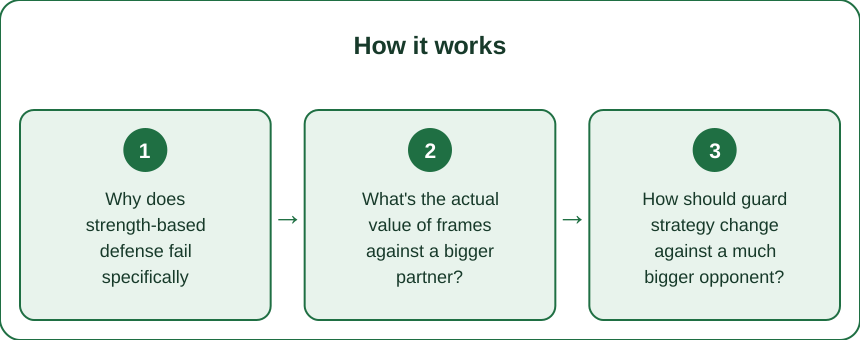
Why does strength-based defense fail specifically against bigger partners?
A significant weight and strength gap means any strength-versus-strength exchange is a contest you’re mathematically likely to lose, regardless of technique quality in that specific moment. The fix isn’t finding more strength — it’s avoiding strength-based exchanges altogether in favor of leverage, angles, and frames that don’t depend on matching their power output.
What’s the actual value of frames against a bigger partner?
Frames (using bones, not muscles, to create and hold distance) — forearms, shins, elbows braced against the opponent’s body — let you control space using structure rather than strength. A well-placed frame holds up against significant weight because it’s leveraging skeletal alignment, not muscular effort, which doesn’t fatigue or lose to a size gap the way muscular resistance does.

How should guard strategy change against a much bigger opponent?
Prioritize guard retention and off-balancing over attempting to sweep through pure strength. A bigger partner’s base is naturally harder to move directly, but their forward pressure, if you can bait and redirect it (breaking their posture forward, then creating an angle), uses their own weight and momentum against their balance rather than trying to match it.
What Nobody Tells You About Training With Bigger Partners
Here’s the part most advice skips: getting crushed sometimes is a normal, expected part of this specific training relationship, not a sign you’re doing something wrong. The value of these rounds is technical, not about winning the exchange — treating every roll against a bigger partner as pure survival practice, rather than expecting technical dominance, changes the entire mental experience of these rounds.
FAQ: Rolling With Bigger Partners Questions, Answered
Should I ask bigger partners to go lighter with me?
This is a completely normal and common request, especially for newer grapplers or when specifically drilling technique rather than live rolling — most experienced partners expect and respect this ask.
Is it normal to feel discouraged after these rounds?
Yes, and it’s worth remembering these rounds are specifically valuable for defensive and positional technique in a way rolling only with similarly-sized partners doesn’t provide.
How long does it take to get more comfortable against bigger partners?
Most people notice a real shift after several months of consistent exposure, as frame usage and positional awareness become more automatic under pressure rather than something to consciously remember mid-roll.
TL;DR:
- Strength-versus-strength exchanges are a losing bet against a real size gap
- Frames use skeletal structure, not muscle, to control distance effectively
- Bait and redirect forward pressure instead of trying to match their base
- Treating these rounds as technical practice, not survival, changes the experience
Size disadvantage is a real constraint, but it’s a strategy problem with a technical answer, not a strength problem with no solution.
Keep Reading
This article is for general informational and styling purposes only. Fit, sizing, and product availability may vary.