How to Keep Training BJJ Around a Nagging Injury Without Making It Worse
Quick Answer: Most nagging BJJ injuries (finger sprains, minor knee tweaks, rib bruises) can be trained around by restricting rolling partners to controlled positional sparring, avoiding the specific joint angle that aggravates it, and prioritizing technique drilling over live rolling until it heals.
A nagging injury doesn’t have to mean a full mat break — it means training smarter for a few weeks.
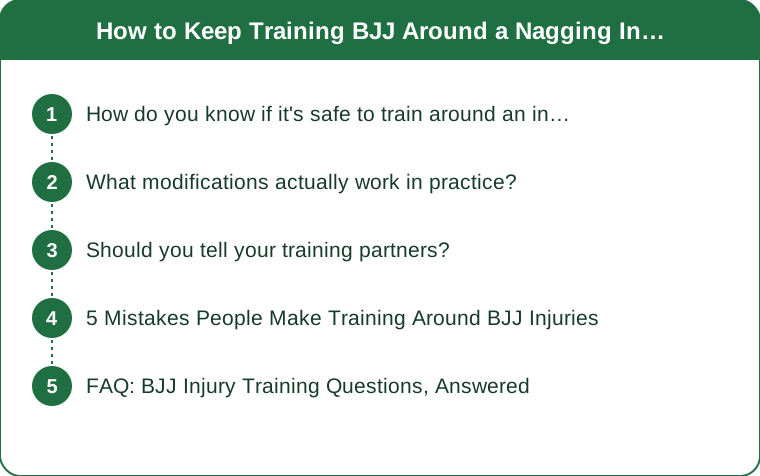
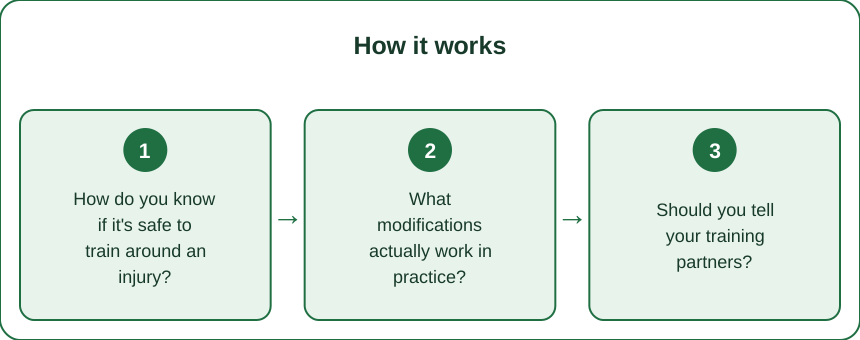
How do you know if it’s safe to train around an injury?
If the injury causes sharp pain during normal daily movement (not just under load), that’s a sign to fully rest rather than modify. A dull ache that only appears under specific joint angles or grips is usually safe to train around with modifications.
What modifications actually work in practice?
Ask training partners for positional-only rounds instead of full live rolling, which removes unpredictable scrambles that most often re-aggravate injuries. Avoid the specific position that stresses the injury — skip berimbolos with a bad shoulder, avoid heel hooks entirely with a knee tweak — while drilling everything else.
Should you tell your training partners?
Always, and specifically. “Go easy” is too vague — tell partners exactly what’s injured and what motion to avoid (“no weight on my left knee, please”) so they can actually adjust instead of guessing.
5 Mistakes People Make Training Around BJJ Injuries
- Rolling at full intensity and just “being careful,” which rarely holds up once adrenaline kicks in.
- Not telling partners specifically what’s hurt.
- Skipping warm-up mobility work for the injured area, which actually helps circulation and healing.
- Ignoring pain that changes character (sharp instead of dull) and continuing anyway.
- Coming back to full intensity too fast once the pain temporarily disappears.
FAQ: BJJ Injury Training Questions, Answered
Is it okay to drill technique with an injury but skip rolling entirely?
Yes, this is often the ideal middle ground — you maintain skill development and mat time without the unpredictability of live rolling.
When should I see a doctor instead of modifying training?
If swelling, sharp pain, or reduced range of motion persists beyond a week, or if there was an acute pop or tear sensation, see a professional before returning to the mats.
Does compression gear actually help while training injured?
It can provide proprioceptive feedback and mild support, but it’s not a substitute for avoiding the aggravating movement. This is general information, not medical advice.
TL;DR:
- Dull, load-only pain is usually safe to train around; sharp daily pain means rest
- Request positional-only rounds and skip the specific aggravating position
- Tell training partners exactly what’s injured, not just “go easy”
- Persistent swelling or sharp pain beyond a week warrants a professional opinion
This is general information, not medical advice — but most long-term BJJ practitioners agree the mat time you protect now is what lets you keep training for years, not just weeks.
Keep Reading
This article is for general informational and styling purposes only. Fit, sizing, and product availability may vary.