Rolling When You Are the Smallest Person in the Room
Quick Answer: Against a significantly larger partner, avoid any position where their weight sits on you and their frames beat yours - flat on your back, inside their closed guard, under side control. Play open guards with your feet on their hips, prioritise angles over strength, and treat grip fighting as the entire game. Technique closes the gap in submissions and sweeps; it never closes the gap in a pure strength exchange, so don’t enter one.
Every smaller person in jiu-jitsu gets told that technique beats size. It’s true in a specific and limited way that nobody explains, and the gap between the slogan and the reality of getting flattened by a 200-pound blue belt is where a lot of people quit in their first six months.
Here’s the more useful version: technique beats size in the positions where technique is the deciding factor. Your job is to spend your rolls in those positions.
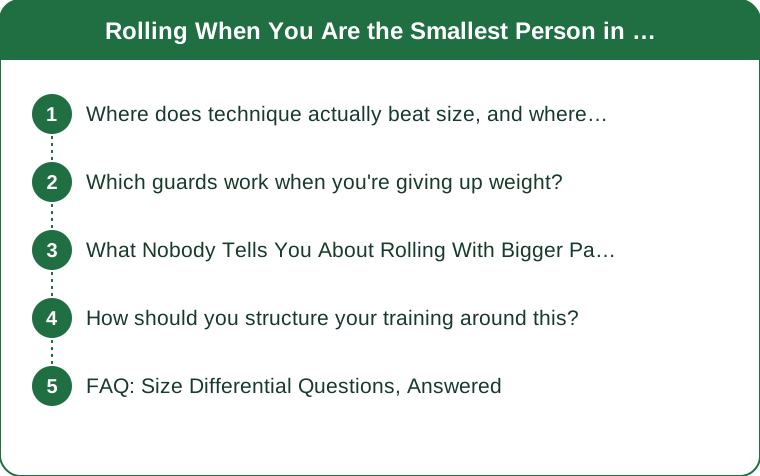
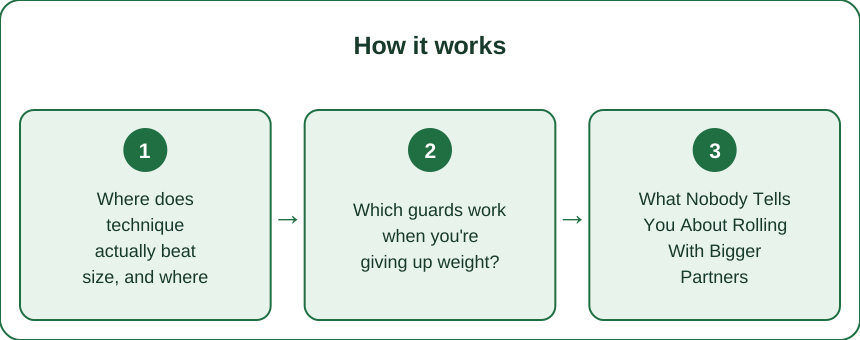
Where does technique actually beat size, and where doesn’t it?
The distinction is the single most useful thing a smaller grappler can learn.
Where technique wins outright:
- Submissions. A properly applied choke works regardless of the size differential. Leverage on a joint is leverage.
- Sweeps using their momentum. Their weight becomes the tool rather than the obstacle.
- Guard retention. Frames, angles, and hip movement don’t require strength if the timing is right.
- Escapes done early. Before the position consolidates, technique is decisive.
Where size wins and technique doesn’t rescue you:
- Any pure pressure position they’ve already established. Once a much heavier person has established a solid side control or mount, their weight is doing continuous work and you’re spending energy just to breathe.
- Grip strength contests. A larger hand and forearm wins a straight grip fight.
- Being flat on your back with them chest to chest. This is where a size disadvantage is most brutal and least recoverable.
- Scrambles that turn into wrestling. Raw strength and mass dominate a scramble.
The strategic conclusion: don’t get into the second category. Escape early rather than well - the moment to escape side control is before it’s set, and this single change matters more than any technique you’ll learn.
Everything else follows from that. Position choice is where a smaller grappler wins or loses the roll, not technical execution.
Which guards work when you’re giving up weight?
Open guards where your feet are between you and them. Closed guard is a trap.
What works well:
- Spider guard and lasso. Your legs are longer than their arms are strong in that position, and it keeps them at range where their weight can’t apply. Excellent for smaller players in the gi.
- De la Riva and reverse De la Riva. Hooks control their base and generate off-balancing without strength.
- Butterfly guard, seated. Puts you at a height where their weight isn’t stacking on you and gives you elevation-based sweeps.
- Shin-to-shin and single-leg X. Both control their base at a distance.
What tends not to work:
- Closed guard against a much larger opponent. Your legs may not close comfortably, they can posture up against your closed guard using strength alone, and if they open and pass you’re immediately in the worst-case position.
- Half guard flat on your back. The version where you’re on your side with an underhook is fine and valuable; the version where you’re flat is where big people make their living.
The unifying principle: your feet and shins should be between your torso and theirs, as much of the time as possible. Legs are the strongest limbs you have and the longest levers. Any position where their chest is on yours has removed your best weapons from the equation.
In no-gi, without grips to hold, the priority on distance management is even higher - butterfly and single-leg X become the primary tools.
What Nobody Tells You About Rolling With Bigger Partners
Five things that take most people two years to work out.
Your cardio has to be better, and it will be. You’re moving more, working harder per exchange, and can’t rest in top position the way they can. This is genuinely unfair and it’s also why smaller grapplers usually develop noticeably better conditioning.
Grip fighting is the whole game and it starts before contact. Whoever establishes grips first dictates the exchange. A smaller player who gets their grips first is in control; one who lets a bigger player grip first is playing defence for the rest of the round. Most beginners treat grips as a preliminary. They’re the primary.
Some partners are not safe to roll with, and declining is normal. A large, spazzy, uncontrolled white belt is a genuine injury risk, and there is nothing wrong with saying no thanks. Good gyms consider this completely normal, and if yours doesn’t, the gym is the problem. This matters more for smaller people than anyone else on the mat.
Tapping early is a strategy, not a weakness. With a large strength differential, submissions arrive faster and with less warning. Tap to position, tap early, tap often. Your training longevity is the actual goal, and nobody remembers who tapped in Tuesday’s open mat.
Progress feels slower and isn’t. You’re solving harder problems, and the same technique takes longer to work against a heavier partner. When you roll with someone your own size, the difference is usually startling - a lot of smaller grapplers discover they’re much better than they thought the first time they compete in their own division.
How should you structure your training around this?
Three concrete adjustments to how you use your mat time.
1. Choose your rolls deliberately. In a typical class you’ll roll four to six rounds. Aim for a mix: some with much bigger partners, some with similar size, some with more experienced smaller partners. Rolling exclusively with much larger people means you never get to practise offence at all, and you end up with excellent defence and no game.
2. Set a goal for each round rather than trying to win. Against someone 40 pounds heavier, ‘win the roll’ isn’t a realistic goal and produces strength-based scrambling. ‘Retain guard for the whole round’, ‘get one sweep attempt’, ‘don’t let them pass to my right side’ are goals that develop the game. This one change transforms what smaller grapplers get out of hard rolls.
3. Build the specific physical qualities that matter. Grip endurance and posterior chain strength are the two that most directly transfer:
- Dead hangs, 3 sets to near-failure, twice a week - grip endurance is trainable and immediately useful
- Deadlifts or hip thrusts, 3 sets of 6-8, twice a week - bridging and sweeping power
- Neck strengthening - genuinely important for injury prevention when heavier people put weight on you
On competition: competing in your own weight class is where a smaller grappler finds out what their technique is actually worth. Many people train for years against bigger partners, compete for the first time, and discover their game works beautifully against people their own size. If you’ve been feeling like you’re not improving, that’s the fastest available reality check.
FAQ: Size Differential Questions, Answered
Should I only roll with people my own size?
No - rolling with bigger partners develops defence, frames, and escapes that you can’t develop any other way. But it should be part of a mix, not the whole diet, because you also need rounds where you get to practise offence.
Is it rude to decline a roll?
Not at all. Injury risk with a much heavier, less controlled partner is real, and every experienced grappler declines rolls. A simple ‘I’ll sit this one out’ needs no explanation.
Which style suits smaller grapplers better, gi or no-gi?
The gi arguably favours smaller players slightly, because grips and friction give more tools to control a stronger opponent and slow the pace. No-gi rewards speed and scrambling. Both are worth training; if you’re choosing where to start, the gi tends to build a more technical base.
How long before I stop getting completely flattened?
Most people report a meaningful shift somewhere between six and eighteen months, and it usually arrives as guard retention improving rather than as any specific technique working. The rolls stop being survival and start being a game.
TL;DR:
- Technique wins in submissions, sweeps, guard retention, and early escapes - not in pressure positions or grip contests
- Escape early rather than well; the time to leave side control is before it’s established
- Play open guards with feet and shins between you and them; closed guard and flat half guard are traps
- Grip fighting isn’t a preliminary to the exchange, it is the exchange
- Set a process goal per round instead of trying to win, and choose a mix of partner sizes
- Tap early, decline unsafe rolls, and train grip endurance and posterior chain
Technique beats size in specific positions. Winning as the smallest person on the mat is mostly about making sure the roll happens in those positions.
Keep Reading
This article is for general informational and styling purposes only. Fit, sizing, and product availability may vary.