Gi vs No-Gi: Which Should a Brand-New Grappler Actually Start With?
Quick Answer: Start with whichever class your gym runs most at times you can actually attend - consistency beats style choice by a mile. If both are equally available, the gi edges it for most beginners: the grips slow the game down enough to think, and gi training converts to no-gi more smoothly than the reverse. But this is a preference question, not a correctness question, and nearly everyone ends up doing both.
People stand outside the sport for months over this decision, as if the first checkbox locks a career path. Meanwhile, inside the gym, most students train whatever is on that evening and stop thinking about it. Here is what actually differs, so you can pick fast and get on the mat.

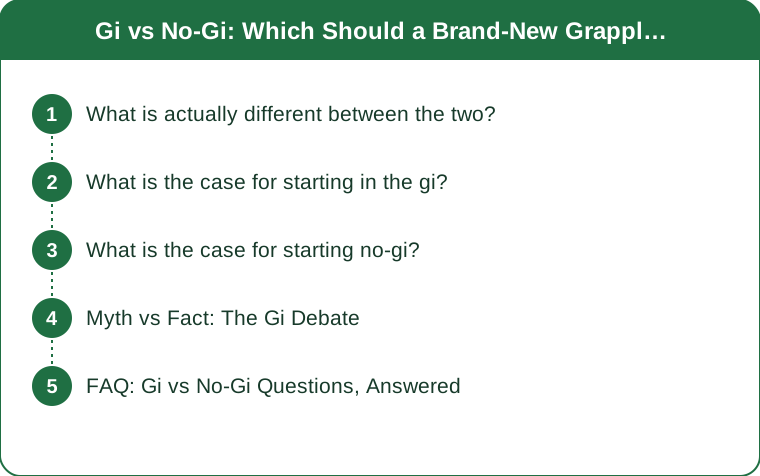
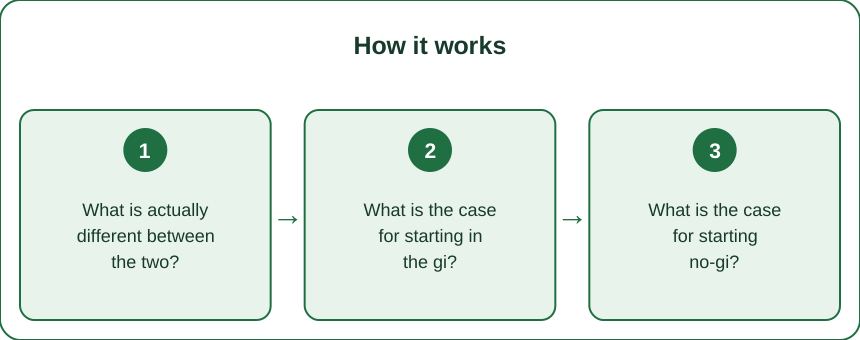
What is actually different between the two?
The uniform, obviously - and everything the uniform enables. The gi is the heavy cotton jacket-and-trousers with a belt; no-gi is a rash guard and shorts or leggings.
On the mat, the gi’s fabric is legal equipment. You grip sleeves, collars, and trouser legs to control, sweep, and choke. That produces a slower, more positional game: once someone has a deep collar grip, you cannot simply pull free, so exchanges become chess-like - grip, counter-grip, break, rebuild. Friction is high, escapes are harder, and precision beats explosiveness more often.
No-gi removes the handles. Control has to come from wrapping the body itself - overhooks, underhooks, wrist rides, head position - and sweat makes everything slippery. The game is faster and scramblier: positions that would be locked-in with cloth become escapable, so transitions chain quickly and athleticism counts for a bit more. Leg attacks also feature more prominently in most no-gi rooms.
What does not differ: the fundamentals. Posture, base, frames, hip escapes, positional hierarchy - the skeleton of jiu jitsu is identical in both wardrobes. Whichever you start, the majority of what you learn in year one transfers whole.
What is the case for starting in the gi?
The gi slows the game to thinking speed. For a beginner drowning in new information, the friction and the grips create pauses - moments where you are stuck, yes, but stuck with time to remember what you were taught. No-gi’s pace gives beginners fewer of those moments; things escape and transition before the lesson lands.
It is harsher on bad habits, in a useful way. In the gi, you cannot slip out of a bad position with speed and sweat - you have to escape properly, with frames and hips. People who build their defence in the gi tend to find no-gi escapes easy; the reverse transition is famously bumpier.
Grip details become a free education. Learning why a grip works, how to break it, and what each grip threatens builds a control vocabulary that quietly carries over to wrist and ankle control in no-gi.
The practical costs are real but small: a gi is an upfront purchase where a rash guard and leggings may already be in your drawer, it is hot - genuinely relevant in August in a gym with mediocre air conditioning - and there is more laundry. One planning note for anyone with long hair and small ears: the gi game involves collar pressure near the face and hair-adjacent scrambles, so the tie-back bun you would use anyway becomes non-negotiable.

What is the case for starting no-gi?
The barrier to the first class is lower. Sports bra, rash guard or fitted tee, shorts with no pockets or leggings - most women own the entire uniform already. When the obstacle to starting is activation energy, removing a purchase helps.
It maps to your existing athleticism. If you come from any fast sport - soccer, dance, climbing - no-gi’s scramble rhythm feels familiar sooner, and early familiarity keeps beginners coming back. The style is also the one you see in most modern competition highlights, so if a specific ruleset inspired you to start, training toward it is honest motivation.
Summer is its recruiting season. A no-gi round in a warm gym is sweaty; a gi round in the same gym is a personal weather system. Plenty of people start no-gi in August and add the gi when the gym cools down in October, which is a perfectly good on-ramp.
And if your goals lean toward self-defence or MMA, no-gi’s body-control emphasis - underhooks, wrist control, head position - translates without the assumption that anyone is wearing a jacket.
The honest tradeoff: beginners in fast rooms can develop a habit of escaping with speed instead of mechanics, which the gi would have refused to allow. A good coach corrects for this; it is a tendency, not a destiny.
Myth vs Fact: The Gi Debate
Myth: You must choose one and stay loyal. Fact: Nearly every gym and nearly every grappler mixes both across the week. The question is only where to start, and the stakes are weeks of comfort, not your future in the sport.
Myth: No-gi is easier for beginners. Fact: It is easier to dress for and harder to think in. Slippery, fast exchanges give beginners less time to apply what they learned. Neither style is easier; they are difficult in different places.
Myth: The gi is just tradition with no practical value. Fact: Clothing grips translate to jackets, sleeves, and collars in the actual world, and gi defence mechanics are the strictest teacher of escapes available. It is a training modality, not a costume.
Myth: Belts only progress if you train gi. Fact: Most schools promote based on your jiu jitsu regardless of which classes you attend; plenty of respected competitors are primarily no-gi athletes. Ask your gym how they handle it rather than assuming.
Myth: You need to be fit before starting either. Fact: The first months build the fitness themselves. Every senior student in the room started as an exhausted beginner - it is the sport’s universal origin story.
FAQ: Gi vs No-Gi Questions, Answered
Should a complete beginner start with gi or no-gi BJJ?
Start with the class you can attend most consistently. If availability is truly equal, the gi’s slower, grip-based game gives most beginners more thinking time, and its habits transfer to no-gi smoothly.
What do I wear to my first no-gi class?
A fitted rash guard or snug tee, plus pocketless shorts or leggings - many women wear leggings under shorts. No zips, no jewelry, nails short, hair tied.
Do I have to buy a gi before my first gi class?
Usually not - most gyms lend loaner gis for trial classes. Ask when you book; buy your own only once you know you are staying.
Is no-gi more dangerous because of leg locks?
Beginner no-gi classes at reputable gyms restrict the risky leg attacks and teach control first. Injury risk in both styles tracks ego and late tapping far more than uniform. Train at a gym that emphasises safety, and tap early.
TL;DR:
- The schedule decides: train whichever style your gym offers most at hours you will actually attend.
- Gi = grips, friction, slower chess; no-gi = body control, scrambles, faster pace. Fundamentals are shared.
- Gi-first builds stricter escape mechanics; no-gi-first lowers the first-class barrier - both are valid doors.
- Nearly everyone ends up doing both within a year, which is why veterans smile at the question.
The decision feels enormous from outside the gym and evaporates within a month inside it. Pick the class that fits your Tuesday, bow onto the mat, and let the sport itself settle the debate.
See It in Motion
Seen here: Super High Waist Embossed Yoga Leggings with Inner Pocket — shop it on bubblelime.com
Keep Reading
This article is for general informational and styling purposes only. Fit, sizing, and product availability may vary.