Why Your First Competition Feels Nothing Like Rolling at Your Gym
Quick Answer: Competition differs from training in four specific ways: the grip fight is far more intense, nobody gives you anything, adrenaline shortens your gas tank dramatically, and the referee and scoring change what is worth doing. None of these are mysterious, and all four can be trained for in your normal gym in the six weeks before an event. The nerves are not the problem - the unfamiliarity is.
You have been rolling well for months. Then the first match starts and you cannot get a grip, cannot breathe, and cannot remember a single thing you know.
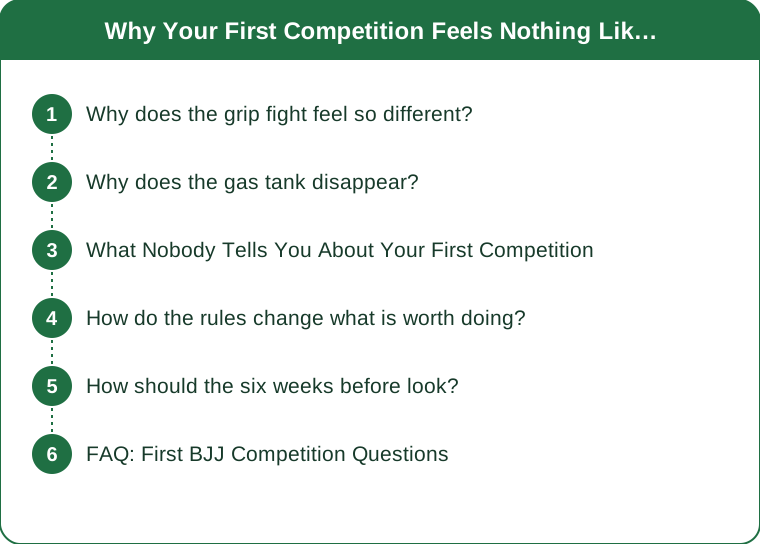
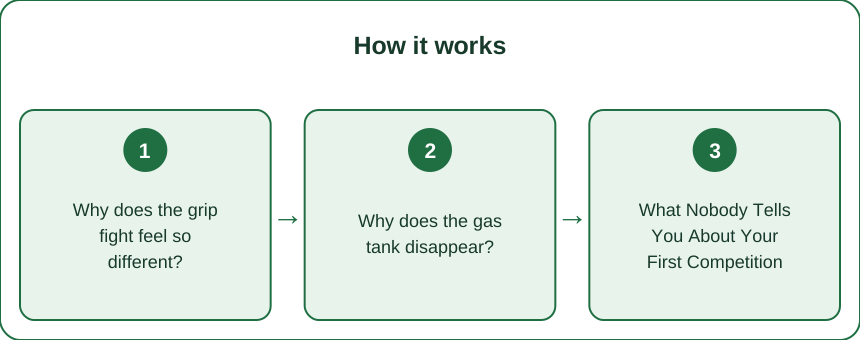
Why does the grip fight feel so different?
Because nobody at a competition lets you settle in. In training, opponents often allow a grip so a round can develop, largely out of social convention. In a match, every grip is contested from the first second, and the opening thirty seconds can be entirely a hand fight.
Grip strength fails before technique does. Forearm fatigue arrives fast under a sustained contested grip fight, and once the hands go, the rest of the game becomes unavailable regardless of how good it is.
Everyone is stiffer, including you. Competition rolls are tighter, more defensive, and lower-risk on both sides, which removes exactly the openings that a flowing gym round provides.
Your A-game may simply never start. Guard players frequently report never getting the grip that begins their sequence, and having no plan B is what turns that into a lost match rather than a slow one.
Train it specifically: grip-fighting-only rounds. Three minutes of standing hand fighting with no takedowns, twice a week for six weeks, changes this more than any technique drilling.
And train from bad grips deliberately. Start rounds with your opponent already holding a dominant grip, so the situation is familiar rather than novel.
Why does the gas tank disappear?
Adrenaline raises heart rate before the match even begins. People commonly walk onto the mat already elevated, which means the match starts from a much higher physiological baseline than a gym round does.
Breathing changes under stress, usually for the worse. Shallow, fast, upper-chest breathing is a normal stress response and it is a poor way to supply working muscles. Most first-time competitors report not breathing properly for the first two minutes.
Everything is done harder than necessary. Grip too tight, frames too rigid, movement too explosive. Tension burns oxygen at a rate a relaxed gym round never approaches, and it is the single largest contributor to gassing out.
Six minutes is a long time when nothing is relaxed. People who roll comfortably for an hour in class regularly find a single competition match harder than the whole session.
Train it: hard rounds with fresh partners and no rest. Ask three teammates to give you a genuine six-minute round each, back to back, once a week. It approximates competition intensity better than a normal class ever will.
And practise breathing on purpose during rolls - nasal breathing where possible, a long exhale when settling into a position. It sounds trivial and it is measurably the difference between minute four and minute five.
What Nobody Tells You About Your First Competition
The waiting is harder than the match. You will arrive early, the schedule will slip, and you may sit for hours in a warm hall being nervous. Bring food, water, a warm layer, headphones, and something to do that is not thinking about your bracket.
Warming up is a logistics problem. Divisions run late, then run suddenly. Do a light warm-up when you think you are close, and be prepared to redo it. Going onto the mat cold is a common and avoidable mistake.
Nobody remembers your match except you. Every competitor is entirely consumed by their own bracket. The imagined audience judging your performance does not exist.
One match is a very small sample. A bad draw, a slip, or a single scoring exchange decides a lot, and reading a match result as a verdict on six months of training is the most common mistake people make afterwards.
Cutting weight badly is worse than competing a division up. For a first competition, register at a weight you can make comfortably. Dehydration hurts performance and, at short notice, is genuinely risky.
And you will be terrible at remembering what happened. Adrenaline disrupts memory formation - most people cannot recall their first match clearly. Have someone film it, because the video is the only usable record.
How do the rules change what is worth doing?
Points reward positional progress, not effort. Takedowns, sweeps, passes, mount, and back control score; grinding hard in a neutral position does not. Knowing the point structure changes what you should chase in the last minute of a close match.
Read the rule set for your specific event, and read it twice. Rules differ between organisations, particularly around leg locks and permitted techniques by belt level, and disqualifications at white and blue belt for illegal techniques are common and entirely avoidable.
Advantages and referee decisions matter in close matches. Near-completions frequently decide outcomes, which means finishing a sweep cleanly rather than half-attempting three is worth more than it is in training.
Stalling calls exist and can cost you. Sitting in a defensive position for long stretches, which is often a perfectly good training strategy, is penalised in competition.
Know the time. Six minutes for white belt in many rule sets, but check yours - and practise looking at the clock during rounds, because match awareness is a trainable skill that nobody trains.
And drill the specific scenario of being down two points with one minute left. It is the most common situation in a close match and the one people are least prepared for.
How should the six weeks before look?
Weeks six to three: normal training plus the specific gaps. Grip-fighting rounds, competition-intensity rounds with fresh partners, and drilling your takedown or guard pull until it is automatic under pressure.
Weeks two to one: reduce volume, keep intensity. Fewer rounds, still hard ones. Accumulated fatigue and a niggling injury going into competition week is a far more common problem than being undertrained.
The final week: light, technical, and no new techniques. Movement, flow rolling, and rest. Nothing learned in the last week will be available under adrenaline anyway.
Sort logistics a week out, not the night before. Gi rules and measurements, weigh-in time and format, venue and travel, what you eat and when. Every one of these is a decision you do not want to make while nervous.
Have three things you plan to do, not thirty. One takedown or guard pull, one sweep or pass, one submission. Under adrenaline, the accessible part of your game shrinks dramatically, and a short list is what survives.
And treat the whole thing as data collection. The purpose of a first competition is to find out what happens to your game under pressure, which is information you cannot get any other way - and it makes the second one an entirely different experience. Train around any existing injury with your coach, and see a medical professional for anything that is not settling. This is general information, not medical advice.
FAQ: First BJJ Competition Questions
Why is competing so much harder than rolling in class?
Four reasons: the grip fight is fully contested from the first second, nobody concedes position, adrenaline raises your heart rate before the match starts, and everything gets done with far more tension than necessary. All four are trainable in a normal gym.
How do I stop gassing out in a BJJ match?
Reduce tension and fix your breathing, since both burn more oxygen than the technique does. Train hard six-minute rounds against fresh partners back to back once a week, and practise deliberate nasal breathing with long exhales while settling into position.
What should I bring to my first jiu jitsu competition?
A legal gi that passes measurement, food and water, a warm layer, headphones, and something to occupy hours of waiting. Schedules slip, then move suddenly - be ready to warm up twice, and have someone film your matches since you will not remember them clearly.
How many techniques should I plan to use in competition?
Three: one takedown or guard pull, one sweep or pass, one submission. Under adrenaline the accessible part of your game shrinks sharply, and a short, deeply drilled list is what actually survives contact.
TL;DR:
- Four specific differences: a fully contested grip fight, nobody conceding position, adrenaline-raised heart rate, and rules that change what is worth doing.
- Grip strength fails before technique does - train standing grip-fight-only rounds twice a week.
- Tension is the main cause of gassing out; deliberate breathing and back-to-back rounds with fresh partners fix most of it.
- Learn your event’s specific rule set - white and blue belt disqualifications for illegal techniques are common and avoidable.
- Plan three techniques, not thirty; adrenaline shrinks the accessible part of your game.
- The waiting is harder than the match, you will not remember it clearly, and one match is a tiny sample.
A first competition is data collection, not a verdict. This is general information, not medical advice.
Keep Reading
This article is for general informational and styling purposes only. Fit, sizing, and product availability may vary.