Why You Tap Late - and What It Is Quietly Costing You
Quick Answer: Most late tapping comes from three things - not wanting to concede to a specific partner, not recognising the submission until it is already locked, and treating the tap as a verdict on your skill. The cost is disproportionate: a joint injury from one late tap can remove months of training, and months of training is what actually makes you good. Tapping early to a submission you cannot escape is a training decision, not a character one.
You knew the armbar was there. You waited two more seconds anyway, and your elbow told you about it for the next three weeks.
Nobody in the room remembers that roll. Your elbow does.

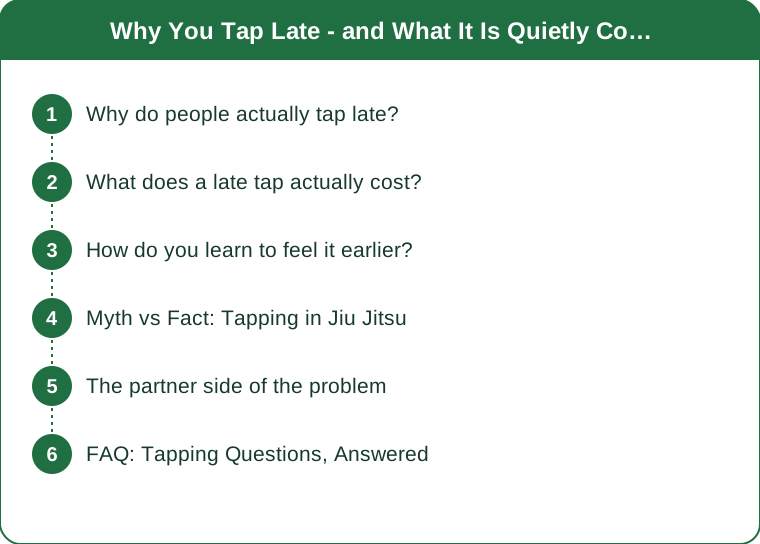
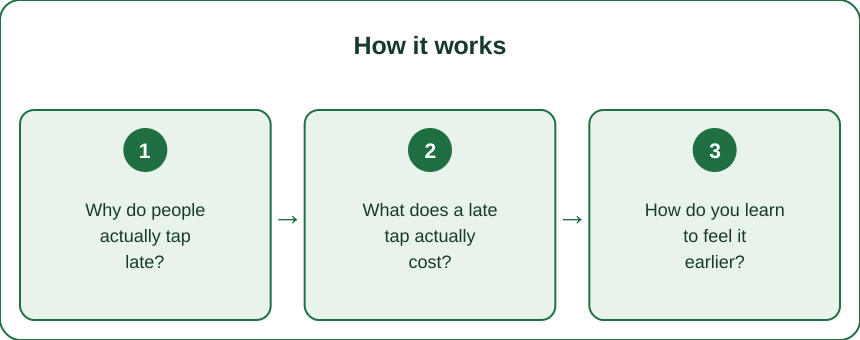
Why do people actually tap late?
It is rarely about pain tolerance, which is what people assume.
The most common reason is social. Tapping to a particular training partner - someone newer, someone smaller, someone you outrank - feels like it means something, so the tap gets delayed while you hunt for an escape that is not there.
The second is recognition lag. Newer grapplers frequently do not know a submission is finished until it is finished. There is a window where the position is locked but the pressure has not arrived, and experience is what teaches you to read that window rather than wait for pain.
The third is identity. If you have decided that tapping means losing, every tap is a small referendum on whether you are any good, and the natural response is to postpone it.
None of those three are toughness. All three are fixable, and the second one fixes itself with time on the mat.
What does a late tap actually cost?
The maths is unforgiving.
A tap costs you a few seconds and a reset. An elbow hyperextension costs six to twelve weeks of limited training, plus the strength you lose in that time, plus the confidence hit that has you rolling tentatively for a month after you return.
And it compounds. Joint injuries in grappling tend to recur, so the second and third versions of the same injury arrive faster and take longer. Plenty of people who quit the sport did not quit because they lost interest - they quit because a joint stopped tolerating training.
The part people underestimate is the training volume itself. Progress in grappling is close to a function of mat hours. A partner who taps early and trains 200 rounds a month will comfortably out-develop someone who tapped late, sat out six weeks, and trained 120.
So the late tap does not just risk injury. It directly reduces the thing that makes you better.
How do you learn to feel it earlier?
Learn the position, not the pain. The reliable skill is recognising when the submission is structurally complete - when the grip is finished, the angle is there, and your escape options have closed - rather than waiting for the sensation to tell you.
Three practical ways to build that:
Get submitted deliberately in drilling. Have a partner apply submissions slowly while you pay attention to the exact moment escape becomes impossible. This is the fastest route and almost nobody does it.
Tap to position, not to pain, in training. If you are caught in a fully locked armbar with no escape, tap. The information you needed was already delivered.
Ask your training partners. Good partners will tell you when you are hanging on past the point of usefulness, and they usually notice before you do.
Also worth knowing: some submissions give almost no warning. Certain leg locks and neck cranks can go from uncomfortable to damaged in a fraction of a second, which is exactly why the recognition skill matters more than the pain-tolerance one.

Myth vs Fact: Tapping in Jiu Jitsu
Myth: Tapping early builds bad habits. Fact: The habit it builds is recognising finished positions, which is genuinely useful information. What builds bad habits is escaping through pain tolerance, because that only works against people who will let go.
Myth: Higher belts tap less. Fact: Experienced grapplers generally tap earlier and more cheerfully than newer ones. They have less to prove, they recognise positions sooner, and most of them have already lost training time to an injury they now consider avoidable.
Myth: The tap is a loss. Fact: In training, the tap is a data point about a position - yours or theirs. Nobody is keeping a record, and the only person tracking the tally is you.
Myth: You should try every escape before tapping. Fact: You should try the escapes that exist. Once the position is structurally finished, further attempts are not escapes, they are just loading a joint.
Myth: Tapping to a lower belt is embarrassing. Fact: It is completely routine, it happens in every gym every night, and the people you imagine are judging you are focused on their own round.
The partner side of the problem
Late tapping is not entirely on the person tapping. The other half is how the submission was applied.
Applying submissions with control - arriving at the finish and increasing pressure progressively rather than snapping into it - gives your partner the window to tap and keeps them on the mat next week. That is not politeness, it is what makes you someone people want to train with.
Be particularly careful with the categories that give little warning: heel hooks and other leg entanglements, neck cranks, and anything applied with a sudden movement. Many gyms restrict leg locks for newer students precisely because the recognition window is so short.
Also pay attention to who you are rolling with. A newer training partner may not know they are caught, so applying a submission slowly and giving a moment for the tap is part of the job.
And if a partner consistently ignores taps or cranks submissions, that is worth raising with an instructor. That is a safety issue, not a personality clash.
FAQ: Tapping Questions, Answered
Is it possible to tap too early?
In training, rarely a problem worth worrying about. If you are tapping to positions you could still escape, the fix is drilling those escapes so you know the difference - not holding on longer in live rounds to test it.
What if I cannot tap with my hands?
Tap with your feet on the mat, or say tap out loud. Verbal taps count everywhere. Make a habit of tapping loudly and visibly rather than with a light touch that can be missed.
How do I know if an injury needs attention?
Swelling, instability, a joint that does not want to move through its normal range, or pain that is still significant after a few days all warrant a proper assessment. Grapplers are notorious for training around things that needed a week off in week one. This is general information, not medical advice.
Should I roll if something is already sore?
You can often train productively with a positional restriction - flow rounds, drilling, or telling partners which submission to avoid. What tends to go badly is hard competitive rounds on an injured joint without telling anyone.
TL;DR:
- Late tapping is usually social or recognition-based, not a pain tolerance issue.
- One joint injury costs six to twelve weeks of mat time, and mat time is what makes you good.
- Learn to recognise a structurally finished position rather than waiting for the pain signal.
- Drill being submitted slowly so you can feel the exact moment escape closes.
- Experienced grapplers tap earlier, not later. They have already paid for the lesson.
- Apply submissions with control - the tap window is your responsibility too.
The people still training in ten years are not the ones who refused to tap. They are the ones who never lost a season to a two-second decision.
Keep Reading
This article is for general informational and styling purposes only. Fit, sizing, and product availability may vary.